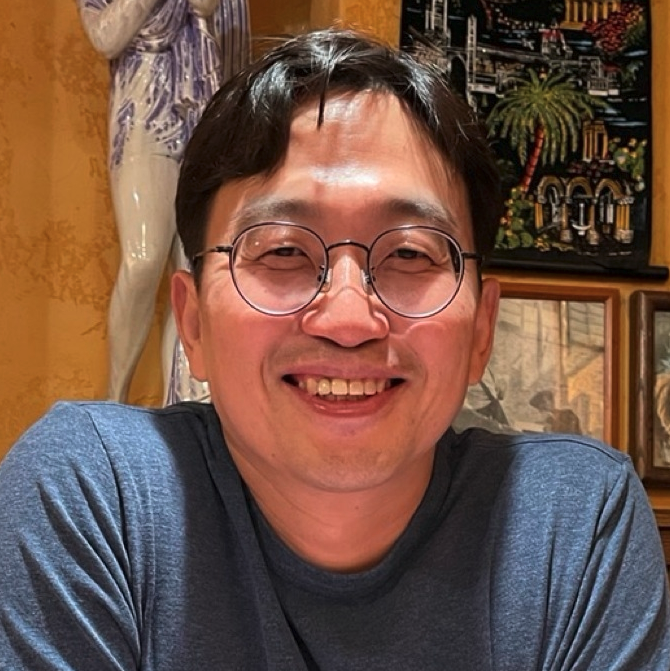
[KOLIS x K-BioX AI Talk] From AlphaFold to Agentic AI - Technology Breakthroughs, Market Forces, and Strategic Thinking for the Next Decade
Speaker Info
- Co-founder & CTO @ Erudio Bio, Inc., CA, USA
- Co-founder & CEO @ Erudio Bio Korea, Inc., Korea
- Co-Founder & Leader & Chair of Silicon Valley AI Nexus (AI Nexus)
- Advisor @ Korean American Semiconductor Professional Alliance (KASPA)
- CGO / Global Managing Partner @ LULUMEDIC
- KFAS-Salzburg Global Leadership Initiative Fellow @ Salzburg Global Seminar, Salzburg, Austria
- Visiting Professor of the Department of Electronic Engineering @ Sogang University, Seoul, South Korea
- Advisory Professor of the Department of Electrical Engineering & Computer Science (EECS) @ Daegu Gyeongbuk Institute of Science & Technology (DGIST), South Korea
- Global Advisory Board Member @ Innovative Future Brain-Inspired Intelligence System Semiconductor of Sogang University
Abstract
The life sciences stand at a rare inflection point. AlphaFold’s breakthrough in protein structure prediction was only the opening act of a much larger transformation now unfolding across drug discovery, diagnostics, and precision medicine. Foundation models trained on biological sequences, molecular graphs, and multi-omics data are rapidly closing the gap between computational prediction and wet-lab reality, while a new generation of agentic AI systems — autonomous workflows that plan, execute, and iterate on complex research tasks — promises to fundamentally reshape how hypotheses are generated, experiments are designed, and therapeutic candidates are identified. This lecture traces the arc from AlphaFold to today’s agentic paradigm, offering life scientists a practitioner’s map of the technologies that matter most and, just as importantly, the ones that are still more hype than substance.
Beyond the technology itself, this talk examines the market forces and investment dynamics that are accelerating — and in some cases distorting — the AI-bio convergence. Drawing on firsthand experience building AI systems at Amazon, co-founding an SK Group AI company, and leading Erudio Bio’s Gates Foundation project–supported cancer diagnostics platform, the speaker connects the dots between Silicon Valley’s AI ecosystem and the life science value chain, from early-stage research tools to FDA/MFDS regulatory pathways to commercial deployment. Participants will gain a clear-eyed view of where capital is flowing, which business models are proving viable, and how the competitive landscape is shifting as big pharma, biotech startups, and tech giants converge on the same opportunities.
The lecture concludes with strategic frameworks for life scientists and biotech leaders navigating this rapidly evolving landscape. Rather than prescribing a single path, it lays out the key decisions — build vs. partner, platform vs. application, U.S. vs. global market entry — and the trade-offs each entails. Whether you are a bench researcher exploring how AI tools can accelerate your pipeline, a biotech entrepreneur evaluating where to place your next bet, or an industry leader rethinking organizational strategy for the agentic era, this talk aims to equip you with the integrated perspective — spanning technology, markets, and human judgment — needed to not merely survive the AI revolution in life sciences, but to thrive in it.
Research Focus
My research and practice span the full breadth of modern AI, grounded in deep mathematical foundations from convex optimization (Stanford University under Prof. Stephen Boyd). Over two decades, I have built and deployed production AI systems across major paradigms: recommender systems and deep learning for e-commerce at Amazon ($200M revenue impact), Bayesian methods and time-series ML for industrial manufacturing at Gauss Labs (SK Group), and most recently large language models, multimodal generative AI, and agentic AI systems.
At Erudio Bio, I bring this cross-paradigm expertise to cancer diagnostics and drug discovery. Our bioTCAD platform, supported by a $1M Gates Foundation grant, uses measurement-anchored computational simulation to bridge the gap between AI-predicted molecular structures and experimentally validated drug design — building on advances like AlphaFold while grounding predictions in wet-lab reality. Our VSA (Versatile Smart Assay) diagnostic platform provides proprietary biophysical measurement data that feeds directly into the computational pipeline, creating a vertically integrated system unique to Erudio Bio. Our longer-term vision is to close the design-synthesize-measure loop with agentic AI — a concrete path from today’s structure prediction breakthroughs toward autonomous drug discovery.
Unique Expertise or Resources
- bioTCAD: Gates Foundation-funded, AI drug discovery platform that anchors computational predictions to experimental measurements — producing proprietary, validated molecular data unavailable in public databases
- VSA diagnostic platform with partnerships spanning Stanford School of Medicine, Harvard Medical School, SNUBH, Institut Pasteur Korea, KRIBB, and National Nanofab Center — 21 patents across semiconductor, AI, and biotech
- Deep mathematical foundations in Convex Optimization (PhD, Stanford, under Prof. Stephen Boyd) applied across the full AI stack — taught at Amazon ML University, Stanford University, Samsung Electronics, and 10+ Korean Universities
- 20+ years scaling AI from research to production: Samsung Semiconductor (12 years, iOpt platform used daily by 200+ engineers), Amazon ($200M revenue impact), Gauss Labs (co-founded as SK Group’s first AI company)
Collaboration Needs
- Computational biologists and biophysicists working on ML force fields, generative molecular design (e.g., diffusion-based backbone generators, sequence design networks), or simulation-based inference — especially groups interested in experimental validation and measurement-anchored calibration approaches.
- Groups developing agentic AI frameworks for lab automation, autonomous experimental design, or closed-loop optimization systems. bioTCAD’s architecture is built around the design-synthesize-measure-recalibrate loop, and we see a natural integration point with teams working on LLM-based scientific agents, active learning oracles for experimental prioritization, or robotic synthesis platforms.
- AI researchers and engineers working on foundation models for molecular representation, transfer learning across chemical series, or surrogate models for rapid property prediction. As bioTCAD generates proprietary, measurement-validated molecular simulation data at a quality not available in public databases, we see strong potential for collaboration with groups that can leverage such data to train or fine-tune next-generation molecular AI models — creating shared value from Erudio Bio’s unique data assets.